Jarvis, Your Build Copilot
Jarvis is the assistant built into DeskClone that helps you build your agents by just talking to it. Ask it a how-to question and it answers; ask it to set something up and it actually does it - creates the agent, configures it, makes knowledge public, publishes, and hands you the code for your website. You stay in control: every change Jarvis makes can be undone in one click.
Where to Find Jarvis
Jarvis lives in the round chat button in the bottom-right corner, on every page except the agent editor (which needs the space). Click it to open the panel. The first time, it greets you and offers a few starting suggestions.
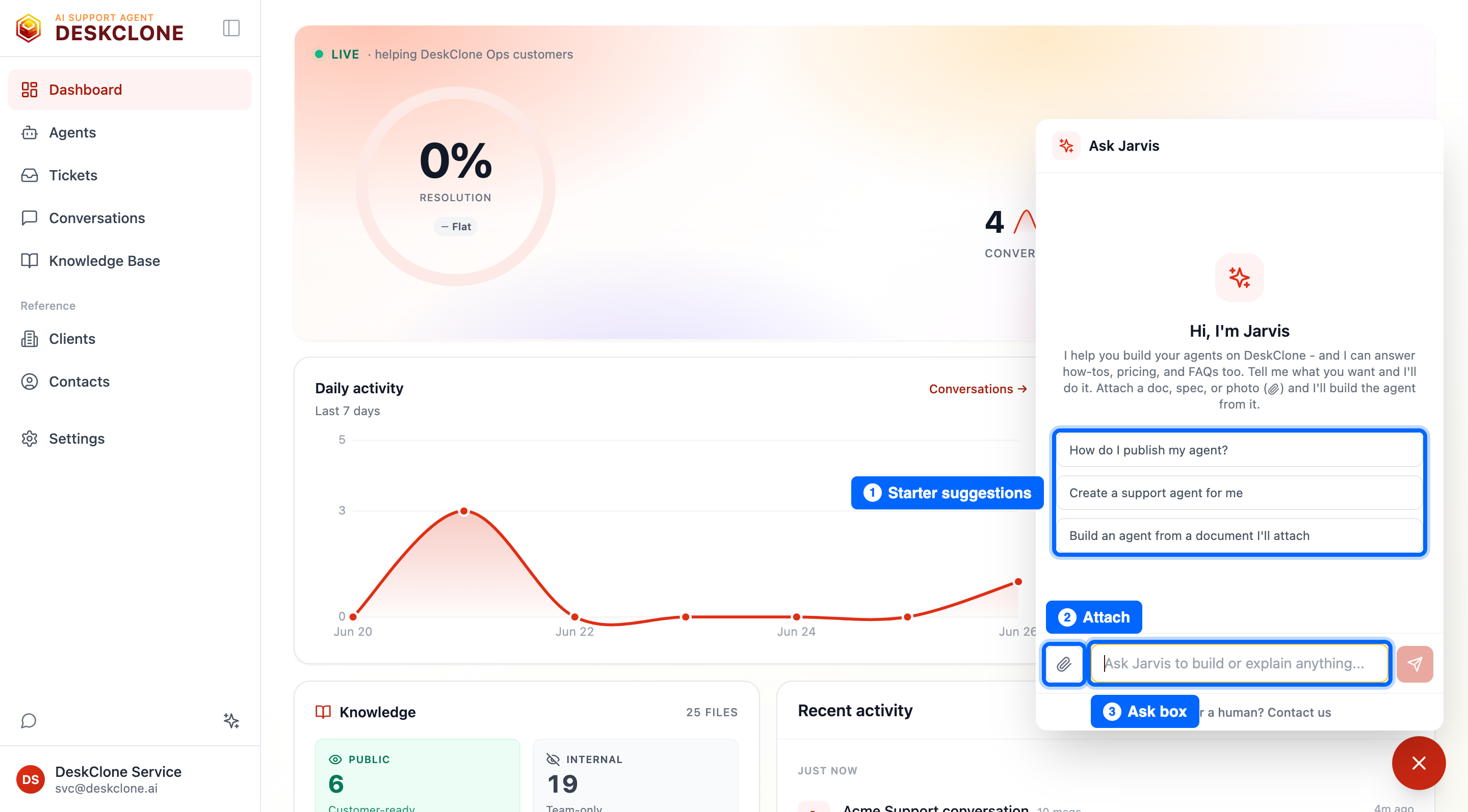
The Ask Jarvis chat panel open in the bottom-right corner, showing the greeting, starter suggestions, and the attach and send controls
You can type a question, click a suggestion, or attach a file - covered below.
Ask a Question
Jarvis answers questions about DeskClone - how to publish, what plans cost, how knowledge works - straight from the product documentation. Ask in your own words.
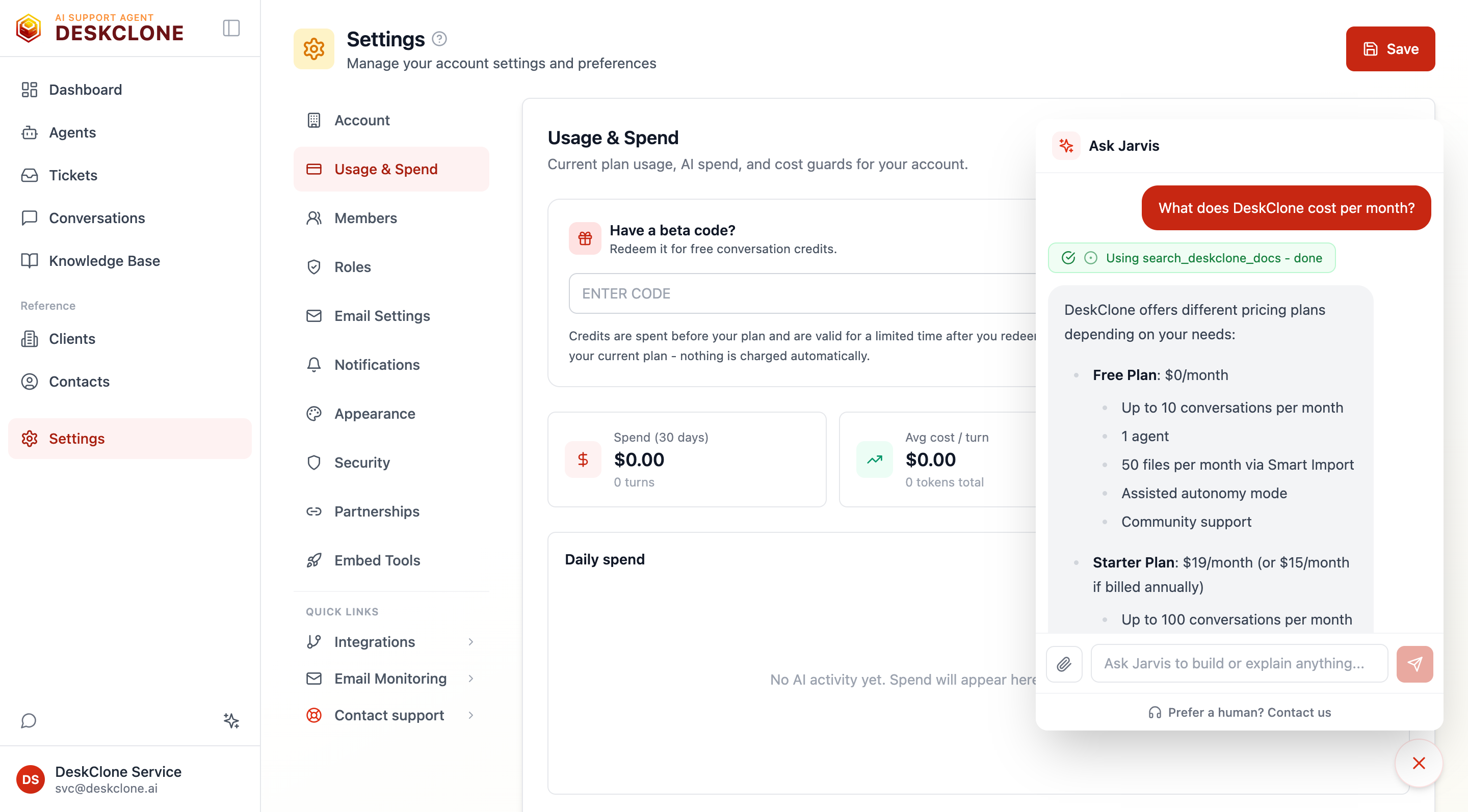
Jarvis answering a question about DeskClone pricing, with the answer drawn from the product documentation
If Jarvis cannot find an answer in the docs, it says so - and often offers to just do the task for you instead.
Build and Configure an Agent
This is where Jarvis shines. Tell it what you want in plain language and it uses your account's real controls to make it happen.
Tell it about your business
Every workspace starts with an agent, so Jarvis configures that one - you never have to create it. Say something like "I run Fernwood Home Goods, a small furniture store - I want the agent to handle orders, shipping and returns." Jarvis sets the personality and tone, and records your business name so the dashboard and emails stop saying "Your Workspace."
Give it your policies
Type your shipping rules, return window, hours, prices - anything a customer might ask. Jarvis saves them as a public knowledge file (for example policies/shipping-and-returns.md) and tells you the file name. That file is what the agent answers from; you will see it on the agent's Knowledge tab.
Refine it
Keep going in plain language: "Make its personality more formal", "Set it to ask visitors for their email", or "Turn on knowledge search." Jarvis applies each change and confirms exactly what it did.
Jarvis can show an agent's current setup, rename and re-describe it, rewrite its personality and instructions, save what you tell it as knowledge, mark knowledge files public or internal, set your business name, change whether it asks for a visitor email, tune its advanced response settings, switch its built-in tools on or off, and create an additional agent when you ask for one - all from the chat.
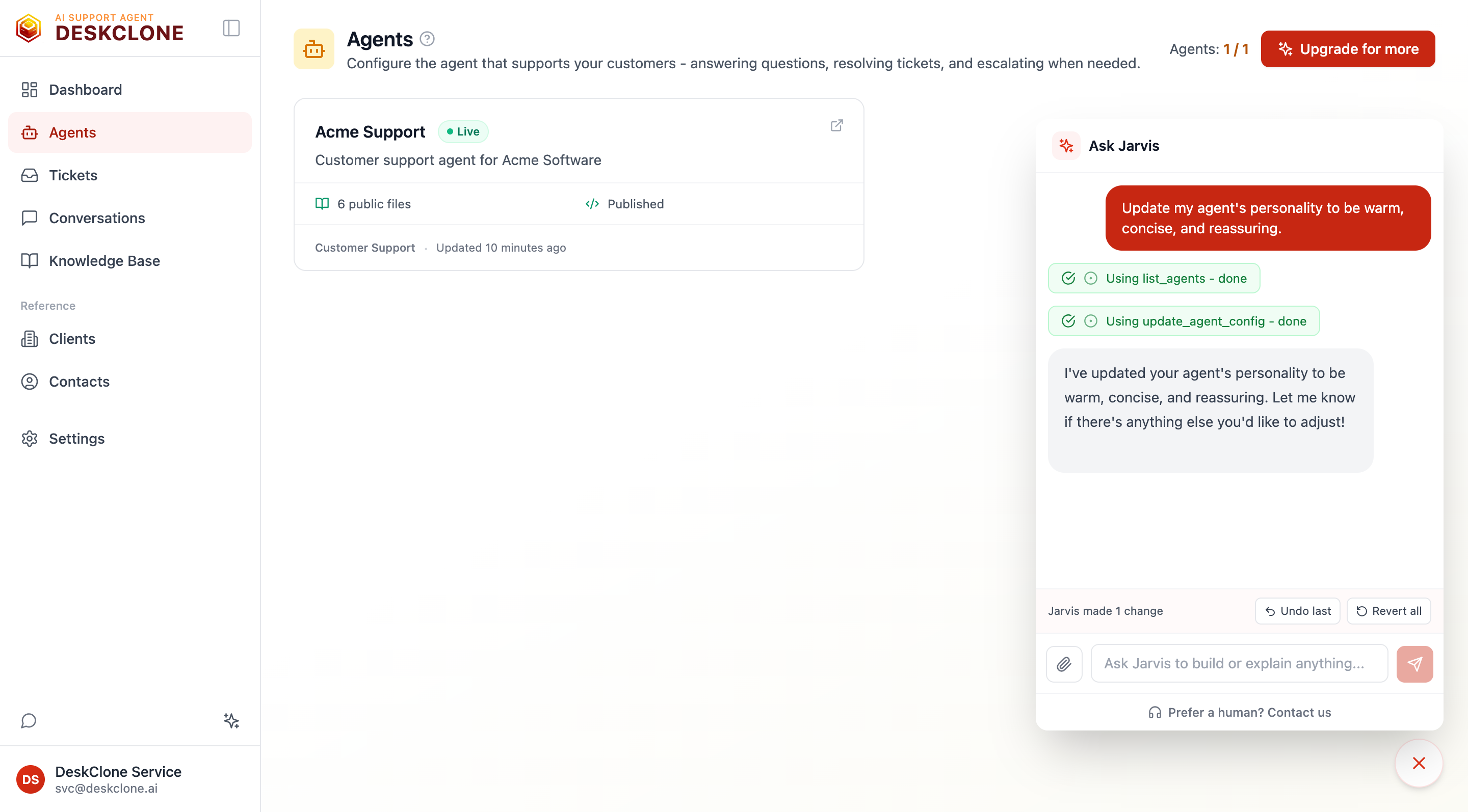
Jarvis confirming it created and configured a new agent, with the changes summarized in the chat
Changes apply immediately - Jarvis does not stop to ask for approval on each step, so a build flows in one go. The Undo controls below are your safety net.
You can trust a "done" from Jarvis. If it ever says it changed something but the change didn't actually go through, it corrects itself in the same message - telling you plainly that your configuration is unchanged and to ask again (or check the relevant tab to see what is currently set). You will never be left believing a change happened when it didn't.
Build an Agent From a Document
If you already have a brief, a support playbook, a spec, an SOP, a spreadsheet, or even a photo of a process on a whiteboard, hand it to Jarvis and it builds the agent from it.
Attach the file
Click the paperclip in the chat and pick one or more files - PDF, Word, slides, spreadsheet, CSV, text, or an image. They appear as chips above the box.
Ask Jarvis to build
Say "Build an agent from this." Jarvis reads the document, infers the agent's purpose, tone, rules, and which tools it needs - from what the document actually says - and sets it up.
Let it learn the content too
Jarvis also imports the document into the agent's knowledge base, so the new agent does not just match the brief - it can answer from it.
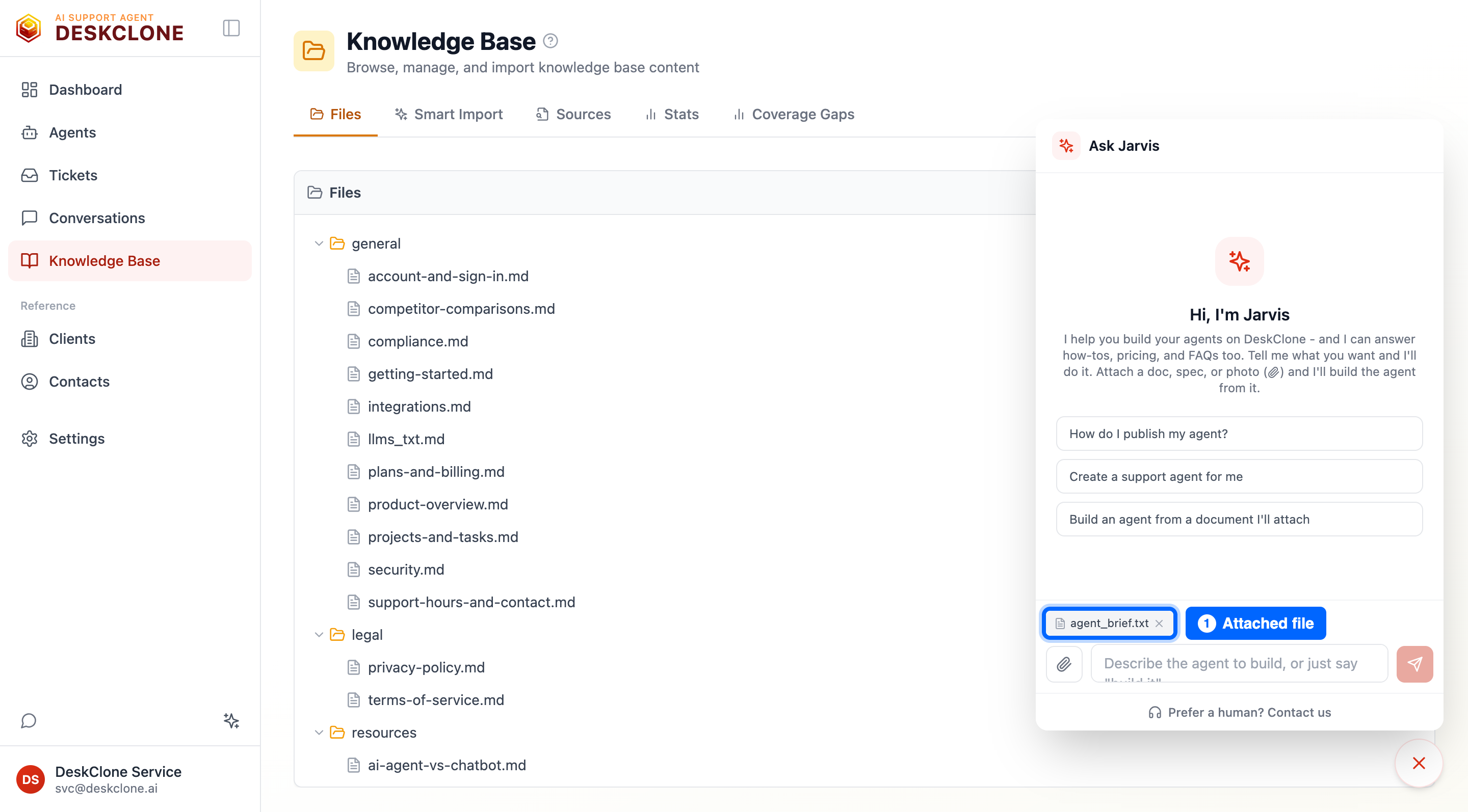
A document attached to the Ask Jarvis chat as a chip, with Jarvis reading it to build an agent
There is nothing industry-specific about this - any document describing any kind of agent works. Jarvis reads yours and decides; it never assumes a template.
Publish and Get Your Website Code
When the agent is ready, ask Jarvis to "Publish it." It publishes the agent, opens the Share tab for you, and replies with the code to add to your website plus a direct share link. Published is not live yet: the agent starts talking to customers the moment that code is on your website (or you share the link). If the agent has no public knowledge yet, Jarvis will not publish it (customers would only get escalations); it offers to save what you have told it as knowledge first. Ask it to "Unpublish" to take the widget back down at any time.
Build Allowance
Talking to Jarvis never uses up your customer conversations. Every plan includes a separate Jarvis build allowance - capacity for building and configuring agents, refreshed automatically through the day. Most users never notice it exists.
If you build a lot in a short stretch, Jarvis lets you know before anything stops:
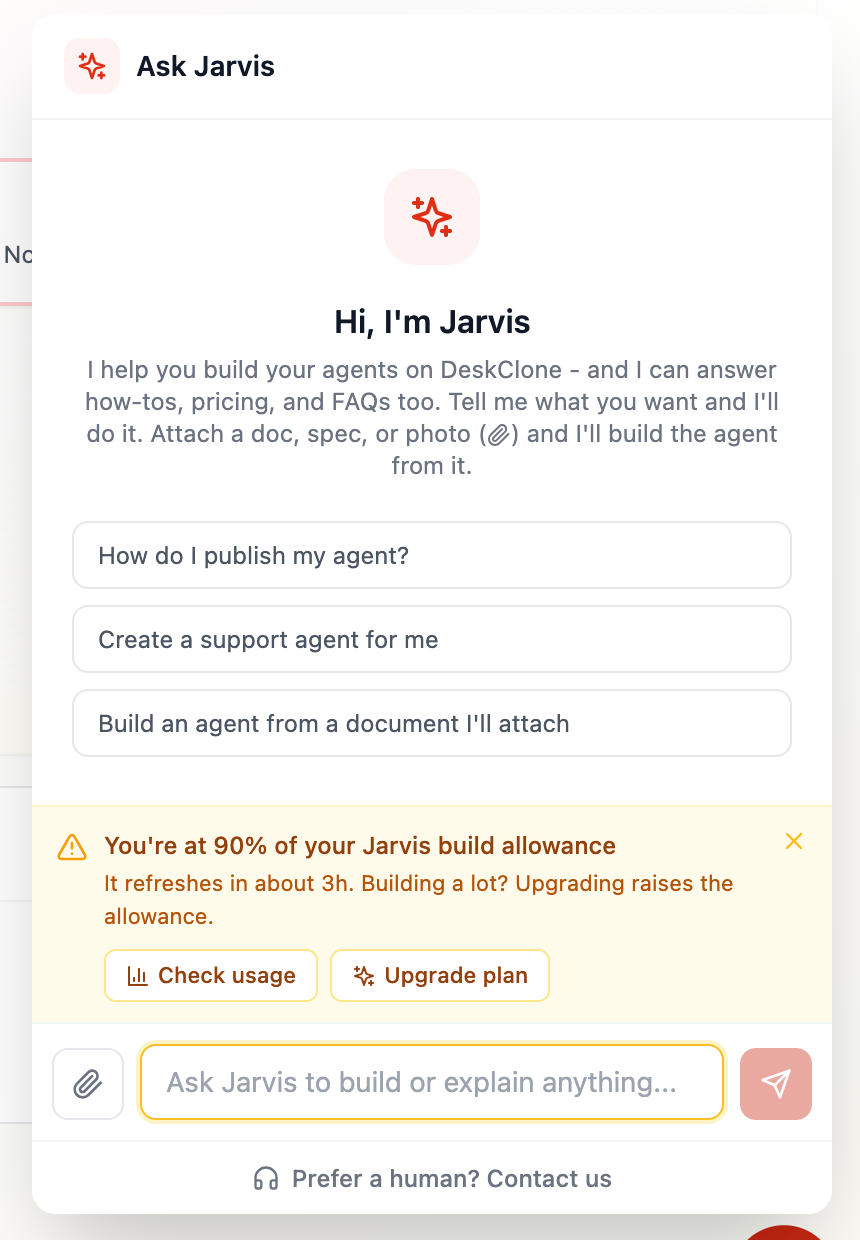
The Ask Jarvis chat showing an amber notice that 90 percent of the build allowance is used, with Check usage and Upgrade plan buttons
- Around 85% used - an amber heads-up appears in the chat with Check usage and Upgrade plan buttons. You can dismiss it and keep building.
- At 100% - Jarvis pauses new build work until the allowance refreshes. Your conversation and agents stay exactly as they are.
You can check how much of the allowance is left anytime - ask Jarvis directly, or open Settings > Usage and look at the Jarvis build allowance card.
Blocked mid-build? Use the contact link in the notice and we will lift the allowance for you right away. Upgrading your plan raises it permanently.
Undo and Revert
Because Jarvis applies changes immediately, it gives you a clear way back. After it makes changes, a small strip appears showing how many changes it made, with two controls:
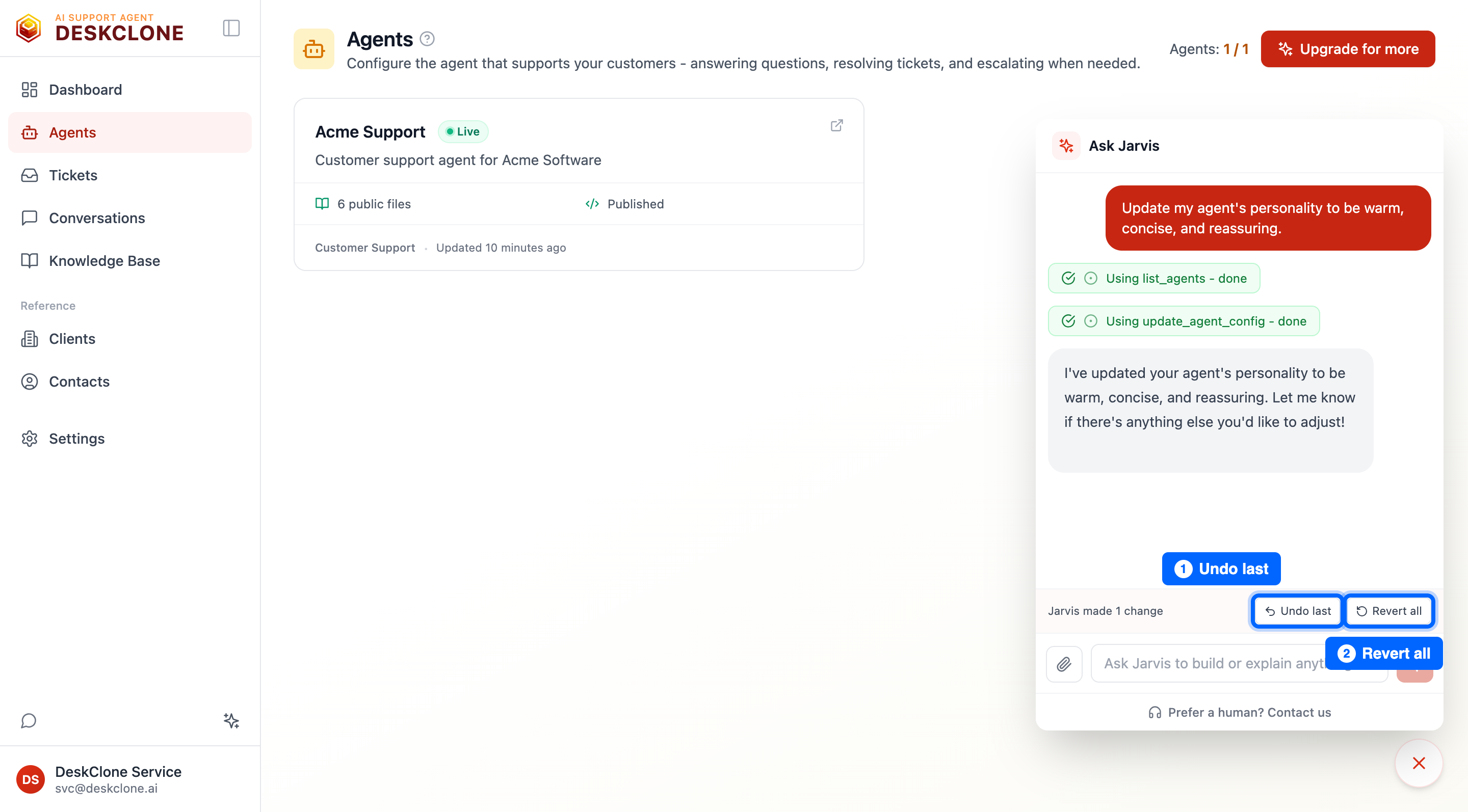
The changes strip under the Ask Jarvis chat showing how many changes were made, with Undo last and Revert all buttons
- Undo last - reverses the most recent change only. Use it when one step went wrong.
- Revert all - rolls back every change from this build, returning your workspace to exactly how it was before you started. Use it to start over cleanly.
Importing a document into your knowledge base is a larger background job and is not part of this one-click Undo. To remove imported content, open Knowledge Base and revert the import from the Jobs view.
What's Next
Jarvis can build the whole thing for you, but it helps to know the pieces it is setting up. Head to Knowledge Base to learn how the content your agent answers from is organized.
Was this page helpful?